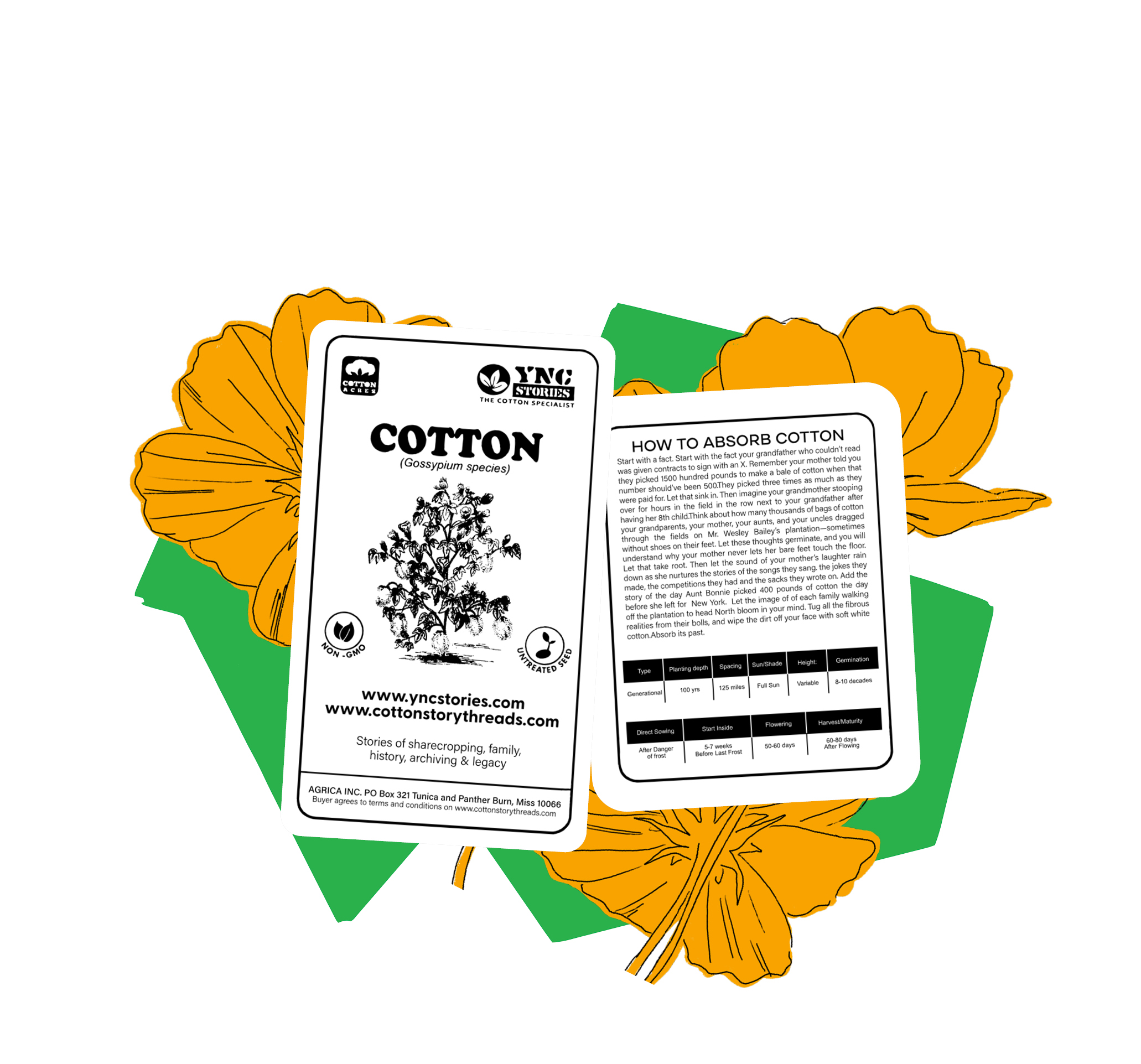
Volume III, Issue I Available for Pre-order Now


If you hold a ball of cotton in your hand, you wouldn’t think about the cost of its softness or the grief it has absorbed. But my family comes from cotton land, so I think about cotton a lot.
In the summer of 2016, I was standing in my mother’s kitchen in Plymouth, Massachusetts, far from Tunica, Mississippi, and the cotton fields where she grew up. My aunt Dorothy walked in carrying something wrapped in a bath towel. “Come on in here for a minute,” she said to my mother, brother and me who were seated in the living room. She then unwrapped a large, aged-leather brown Bible with an embossed relief. “This Bible is probably over 100-years-old,” she said as she placed it on the table.
It was about 14 inches long and 12 inches wide, with black electric tape around the spine to hold it together. Despite the tape, I touched it with reverence. Me, my mother, aunt Dorothy, and my older brother Murray stood around it. My aunt Dorothy looked up at my brother, the pastor, and declared, “When I’m gone, I’m going to pass this down to you.” I was looking at the book and holding the treasure in my hands, feeling a bit dejected. I wanted to say, “But I’m the writer. Why wouldn’t you leave this book to me?”
As they talk, I thumb through the thin pages. In the center, I see where my great-grandmother Louise has written the date of her wedding and the dates each of her grandchildren were born, including my mother. As I go through the pages, I see an envelope with the same cursive handwriting. I quickly take it out of the book before closing it again, slip the envelope in my bag, and say nothing.
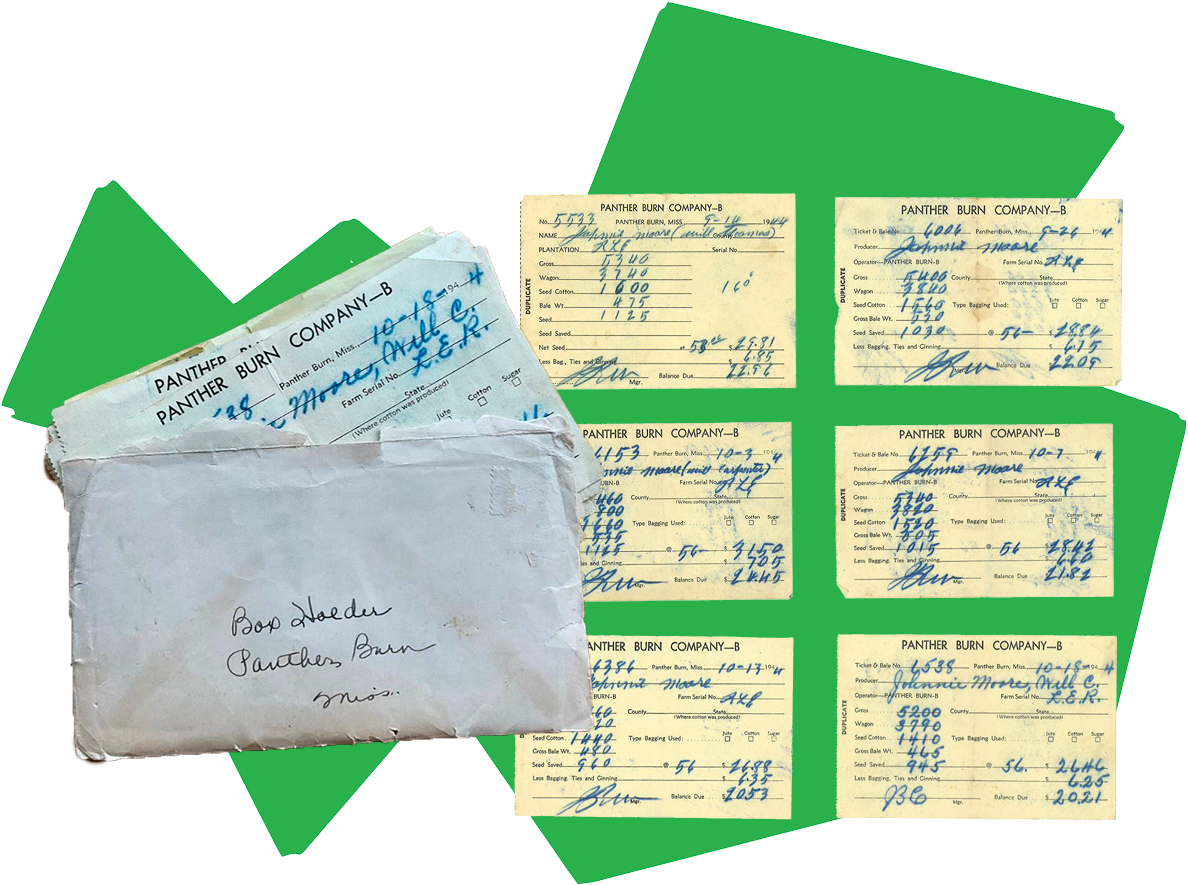
When I go home, I open the envelope to find cotton bale receipts written in my great-grandmother’s handwriting from the years of 1944 through 1946. She signed them with her husband’s name, but it was she who wrote them and kept the records. She understood the documentation meant survival as well as an exhibition of power.
Gross: 5200
Wagon: 3790
Seed Cotton: 1410
Cotton bale weight: 465
Seed saved: 945
My mother doesn’t remember any of this. She didn’t even remember that her grandmother had not only left her mother that Bible but also the deed to her land. With her parents gone and the deed lost, our family Bible proves what outlives memory: receipts don’t lie.

The receipts meant my great-grandmother and her husband, “Grandpa Johnnie,” were renters who eventually purchased their own land. The cotton receipts from 1944 through 1947 reveal that my maternal great-grandparents were part of a small but significant group of Black farmers and landowners who maintain ownership and control over their labor. These receipts, issued only to tenant farmers and landowners, represent a form of Black economic self-sufficiency that was rare in the South, particularly in the 1940s and in Mississippi.
Years later, I hung the receipts on a clothesline in a gallery, exhibited them, and aired my family history like laundry to make their labor visible. I photographed a cotton ball in a light box to illuminate its softness and framed it so viewers could consider what that softness had cost my family and many other Black families in the South.
When I think of my mother, with a gunnysack strapped around her small body, picking cotton alongside her mother, father, and seven siblings, and when I think of my grandfather, who never learned to read, my matrilineal great-grandmother Louise and her receipts give me an alternate narrative to hold.
When I see how far my mother has come—that she can open her home to others and rest her grandmother’s Bible on her kitchen table—I feel less sad about her missing out on her own land in her home state.
My mother is living happily in Massachusetts now, in a house she inherited when my father died. She doesn’t want to return to Mississippi. I have learned that all that is lost is not always a loss.
Grandma Lou’s Bible is still here; my brother will inherit it. The receipts, however, are mine. Yes, I stole them, but I also preserved them. I will leave them for a family member I may never meet. They will act as another receipt, another record, another refusal to disappear.
Start with a fact. Start with the fact your grandfather, who couldn’t read, was given contracts to sign with an X. Remember your mother told you they picked 1,500 pounds to make a bale of cotton, when that number should’ve been 500. They picked three times as much as they were paid for. Let that sink in.
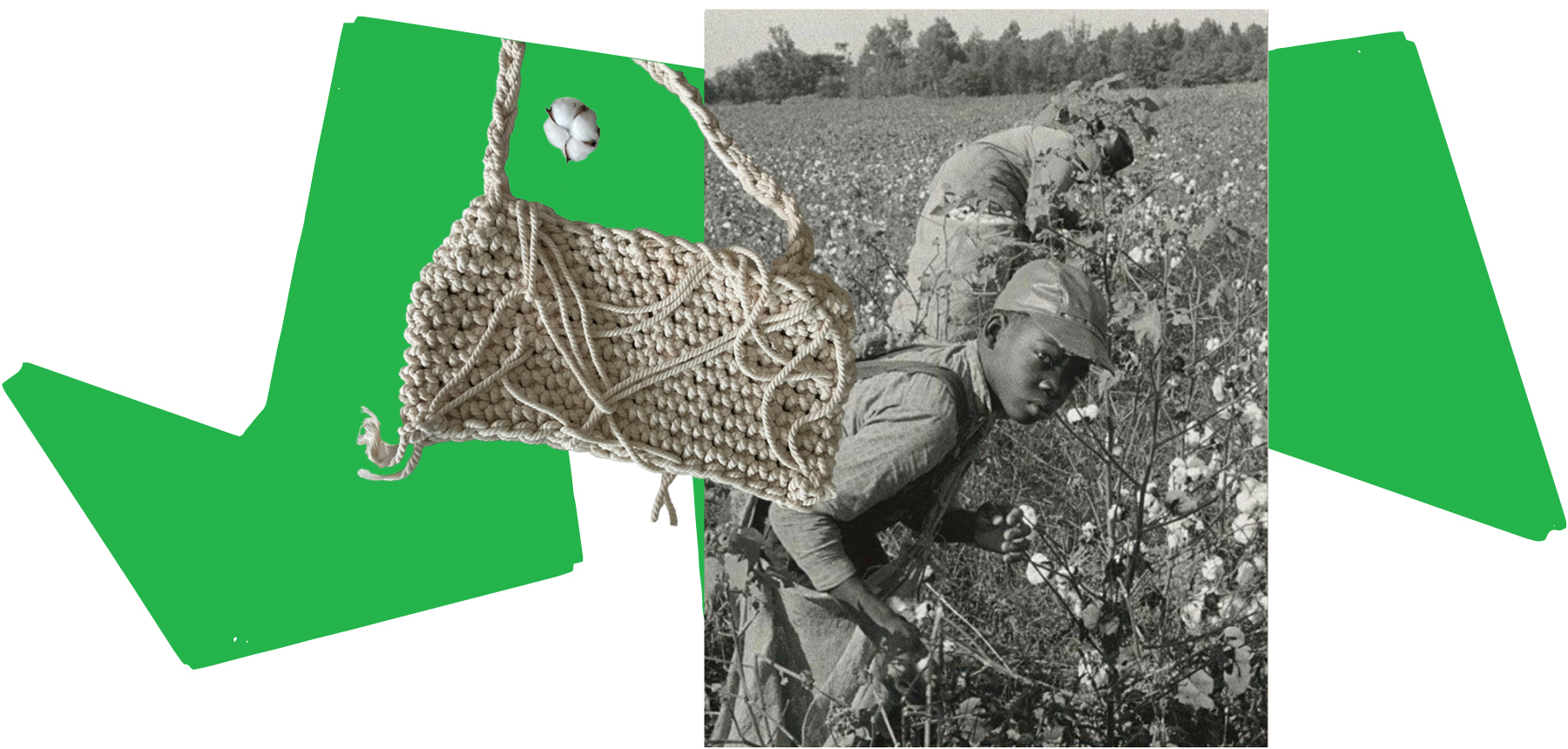
Then imagine your grandmother stooping over for hours in the field, in the row next to your grandfather, after having her eighth child. Think about how many thousands of bags of cotton your grandparents, your mother, your aunts, and your uncles dragged through the fields on Mr. Wesley Bailey’s plantation, sometimes without shoes on their feet. Let these thoughts germinate, and you will understand why your mother never lets her bare feet touch the floor. Let that take root.
Then let the sound of your mother’s laughter rain down as she nurtures the stories of the songs they sang, the jokes they made, the competitions they had, and the sacks they wrote on. Add the story of the day Aunt Bonnie picked 400 pounds of cotton the day before she left for New York. Let the image of each family walking off the plantation to head north bloom in your mind. Tug all the stories from their boils, wipe the dirt off your face with a soft, white circle of cotton, while you absorb some of its past.